

Review unit supplied free of charge by Steelseries.
Steelseries have been on a roll really, pumping out a bunch of solid mice, keyboards and headsets that have all done rather well critically and commercially. The Rival series of mice in particular has got a lot of fans, and indeed it wasn’t that long ago I reviewed the Rival 700 with its little OLED screen. You should go read that review. Really. Do it. So now it’s time to gets all handsy with the Rival 600, a mouse that’s a full 100 less good than the 700, right? That’s how it works, yeah?
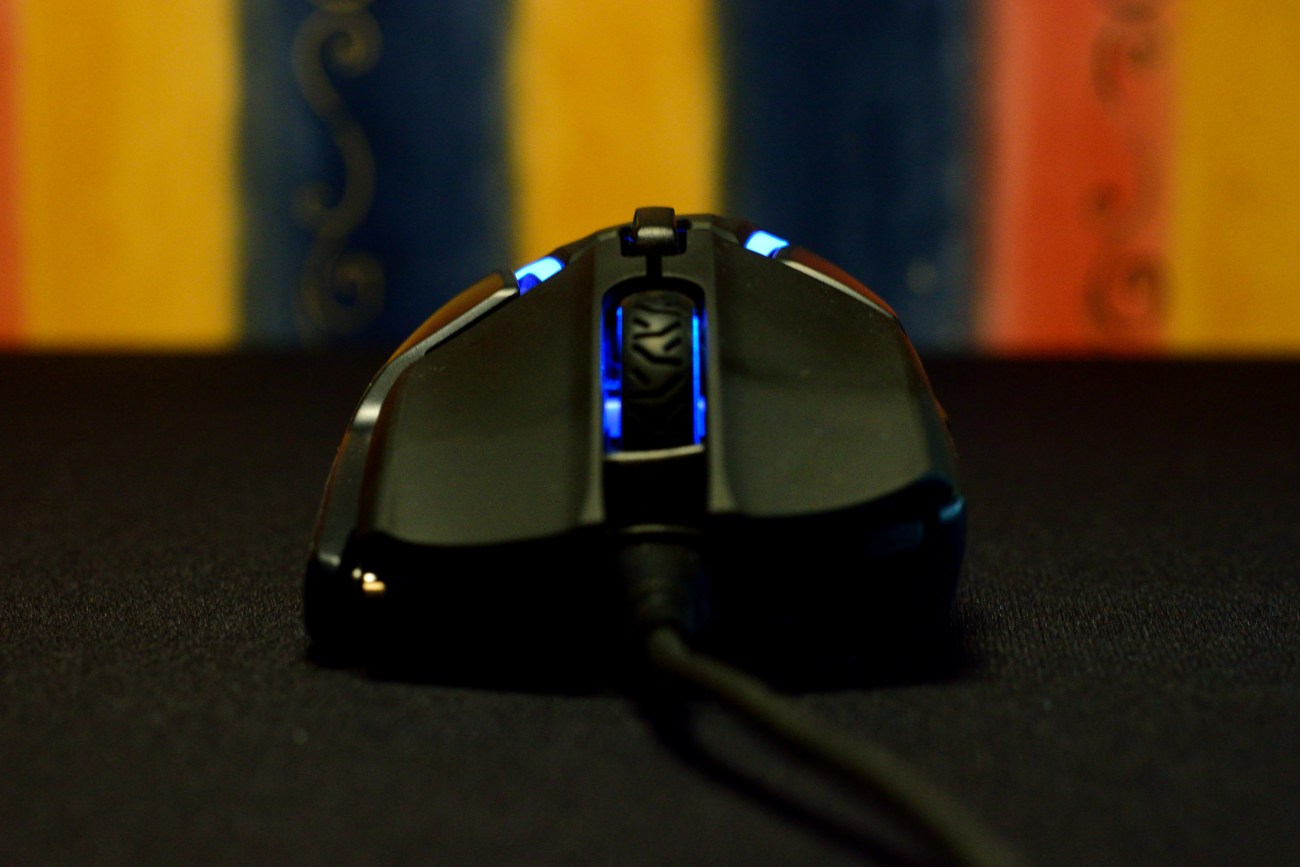
It’s 2018 so we have to have that light-up bling, but this time Steelseries have upped their game with a total of eight points of customization, with the two thick strips atop the mouse each getting three zones to play with via the Steelseries Engine software. With this you can create some nice color blends or just slap the whole thing onto cycle mode so that it becomes a rainbow of color that is sure to attract any nearby unicorns looking for a mate. The colors are vibrant and deep, though the system still has the typical RGB LED weakness when it comes to displaying yellow and white, which come out looking slightly green and slightly blue respectively.

That brings use to the overall looks and for the most part I like it. The amount of lighting is perhaps too strong for many folk, but you can disable each lighting section individually in order to tone it down if you want something a tad more subtle. It has a nice sleek aesthetic free of absurd angles or pointless tat. It’s finished with a flat black paintjob that shows up marks, so if you’re a bit obsessive about keeping your stuff looking clean this mouse might just drive you crazy.
As for the build quality it hits the mark, too. There’s no sense of flimsy plastic or creaking when you grip it hard, and even when you give it a little shake there isn’t that slight rattling sound typically heard in a mouse. I’ve really got no complaints about hows it built and how it looks.
It fits into the hand pretty well, too. It’s on the larger side and thus does tend to suit people with chunky slabs of meat at the end of their arms, but even with my small hands it was still rather nice to hold. The hump and downward slope toward the right naturally put my hand into a comfy position that avoided my pinky finger dragging, something which I find happens quite often. I did miss the curved wing on the right that my Razer Kraken has, but the silicon grips on both sides of the Rival do a good job of keeping fingers in place. In short, it isn’t the comfiest mouse I’ve had the pleasure of groping indecently but it’s firmly in the “good” category.
What I didn’t like was the rubber cable. Rubber tends to grip surfaces more and can catch fairly easily. I would rather have had a braided cable, even if it does add some weight, but that’s sold separately which I find a bit insulting considering the £80 price-tag
On the right side, we’ve got two slim buttons with the first being quite long so that your thumb can sit nicely along it or just below it. The next thumb button is shorter and for my relatively small hands sits a little too far away, but I can click it with the end of my thumb without needing to stretch so that’s fine. There’s a third button, too, positioned quite close to the nose of the mouse that is impossible to reach without stretching your hand awkwardly like a contortionist, regardless of whether you’re using palm grip or claw grip. It’s positioning meant I never used it, and it almost feels like Steelseries didn’t think anyone would use it, either, as it comes deactivated by default.
The left click feels nice and responsive and has a consistent feel regardless of where your finger is positioned. The right clicks feels perhaps a touch mushier that in its lefty counterpart but is still nice to use and again is consistent wherever you happen to click it.
As for the mouse wheel, it’s notched so that in-game when you’re doing something like swapping weapons you don’t accidentally go from assault rifle to a pair of nail clippers stowed in your backpack. This, of course, means it isn’t nice and smooth for when you’re just browsing the web for the latest Blu-ray deals or the finest of naughty videos, but the notches aren’t obtrusive to the point of being annoying. It’s a nice balance. The wheel can be clicked with a satisfying noise being your reward, though it doesn’t support left and right clicks, which is a bit of a shame because it’s a simple way of adding extra functionality. I don’t normally use them, but I know quite a few folk who do.
On top of the mouse you’ll also find the CPI (counts-per-inch) button that lets you swap between two CPI settings that you select in the software. While you probably won’t find yourself swapping CPI too much in-game it would still have been nice to see the button support more than just two settings. You might want a nice, slow setting for sniper work, a faster one for twitch shooting with a machine gun and something in between for an assault rifle, for example.

But now we get to one of the mouse’s two nifty part tricks; the Rival 600 comes with eight 4g weights that can be slotted into the mouse. Basically, on both sides of the Rival are panels held in place using magnets, and into these little hide-aways, you can house however many weights you want, raising the mouse’s default 96g weight to a maximum heft of 128g. With this, you can happily tune the mouse however you like, and can even favor one side over the other if prefer. I typically like a little heft in my hand, that way if anyone annoys me I have the reassuring feeling that I can always clobber them with my mouse.
These removable panels might also open up the possibility of Steelseries releasing new side panels for added customization, but right now there are no announced plans to do so.
The big selling point is the dual sensor system that promises to completely remove lift and drift issues. The main sensor is a Truemove 300 which is capable of a maximum CPI of 12,000, a number that would send your cursor into the stratosphere if you dared use it, with true one-to-one tracking at up to a maximum 3,500 CPI. While I don’t think the double sensors completely removes problems with mouse lifting, it did cut the effects down significantly which is a massive selling point for people who tend to lift a lot. But more importantly, the TrueMove sensor is a beast and ran faultlessly during my testing. It’s incredibly accurate and never missed a movement I made no matter how small.

Everything is handled through the Steelseries Engine software which is a doddle to use. As you would pretty much expect you can play around with settings for things like mouse acceleration and lift-off distance, fiddle with the CPI and alter the lighting, either using your own or one of the presets. You can change what the various buttons do, too, perhaps opting to make the third side-button act like a keyboard command or create a macro for it. You also get access to the Steelseries apps which work in tandem with games and the RGB lighting to do a variety of things like display health, but unsurprisingly they don’t work very well on a mouse where your hand covers up the majority of the LEDs
Although it is arguably a bit too expensive at £80 the Rival 600 is yet another success from Steelseries who have really been putting out good products. It’s nice to hold and game with, looks rather stylish with its LED bling and performs brilliantly from a technical perspective. The customizable weight is a nice touch, too, and while I’m not sure the dual sensors will really help the average gamer it’s still a great feature for Steelseries to tout to serious players who do tend to lift a lot. Once you bring all this stuff together you’ve got a bloody good mouse. What’s weird, though, is that these days just being really damn good almost isn’t enough. Up in this price bracket we’ve got piles of mice to choose from, and in that sense the Rival 600 perhaps doesn’t stand out. But then again, how do you really make any mouse stand out without adding a host of pointless gimmicks? No, it’s better just to have something that just does what it’s meant to do, and do it extremely well.

Like this:
Like
Loading...
Comments
Post a Comment